
People Counter and Footfall Counting System for Retail, Workplaces and Venues
A people counter counts the people entering, leaving and occupying a space. A people counting system turns those counts into live occupancy, footfall analytics and automated reports. CountIQ does it for retail, offices, transport hubs and public venues using compatible Axis cameras you may already own.
What does a people counting system detect?
A modern people counting system uses AI-powered cameras to generate live reports, analytics, and alerts. It captures counts of people, vehicles, and bikes, monitors real-time occupancy levels, and defines custom zones across multiple cameras or entire sites.
Count Movement
In and out
Live Occupancy
Real-time monitoring
Custom Zones
Multiple cameras
Event Detection
Smart alerts
How People Counting Systems Work
Go from zero visibility to real-time occupancy insights in days, not months — using cameras you may already have.
Connect Your Cameras
- Works with compatible Axis cameras you already own, so those entrances need no dedicated sensors
- Installs in days, not weeks, with minimal disruption to your operations
- AI runs on-camera, so there are no extra servers to manage
See Real-Time Occupancy Data
- Live people counts and occupancy levels update in seconds, not hours
- Track foot traffic trends across every entrance, zone, and location from one dashboard
- Automated reports delivered to your inbox daily, weekly, or monthly
Make Smarter Decisions
- Optimise staffing schedules around actual peak hours instead of guesswork
- Measure the real impact of marketing campaigns, events, and layout changes
- Set capacity alerts and compliance thresholds that trigger automatically
People Counting Technologies Compared
There are six common ways to count people. The right one depends on the space, the hardware you already have and how exact the number needs to be.
| Technology | How it counts | Strengths | Limits |
|---|---|---|---|
| Camera with on-board analytics | AI on the camera detects people crossing a line or occupying a zone | Can reuse compatible cameras already installed; tells direction; counts people who enter together | Needs a suitable mounting position and lighting, and a camera that supports the analytics |
| Overhead 3D sensor | A dedicated stereo or time-of-flight sensor above the doorway measures depth to separate people | Purpose-built for busy doorways | An extra device to buy, cable, power and mount at every entrance |
| Thermal sensor | Detects body heat | Works in darkness and produces no recognisable image | Less detail, so groups and warm backgrounds are harder to separate |
| LiDAR | Laser ranging builds a 3D view of a wide area | Covers large open spaces, works in darkness, no camera image | Higher hardware cost and specialist setup |
| Infrared beam | Counts each time a beam across the doorway is broken | Cheap and simple | Cannot separate people walking side by side; basic units cannot tell direction |
| Wi-Fi or Bluetooth | Estimates presence from phone signals | Shows movement between areas without door hardware | An estimate, not a count; depends on phones being detectable |
CountIQ uses the first approach: counting runs on compatible Axis cameras and the counts are sent to a cloud dashboard. Read more about on-camera people counting without dedicated sensors, or see the full camera vs LiDAR vs thermal comparison.
People Counting Dashboard & Analytics
View live counts, trends, and event data with real-time updates. Generate comprehensive reports and schedule automated email distribution.
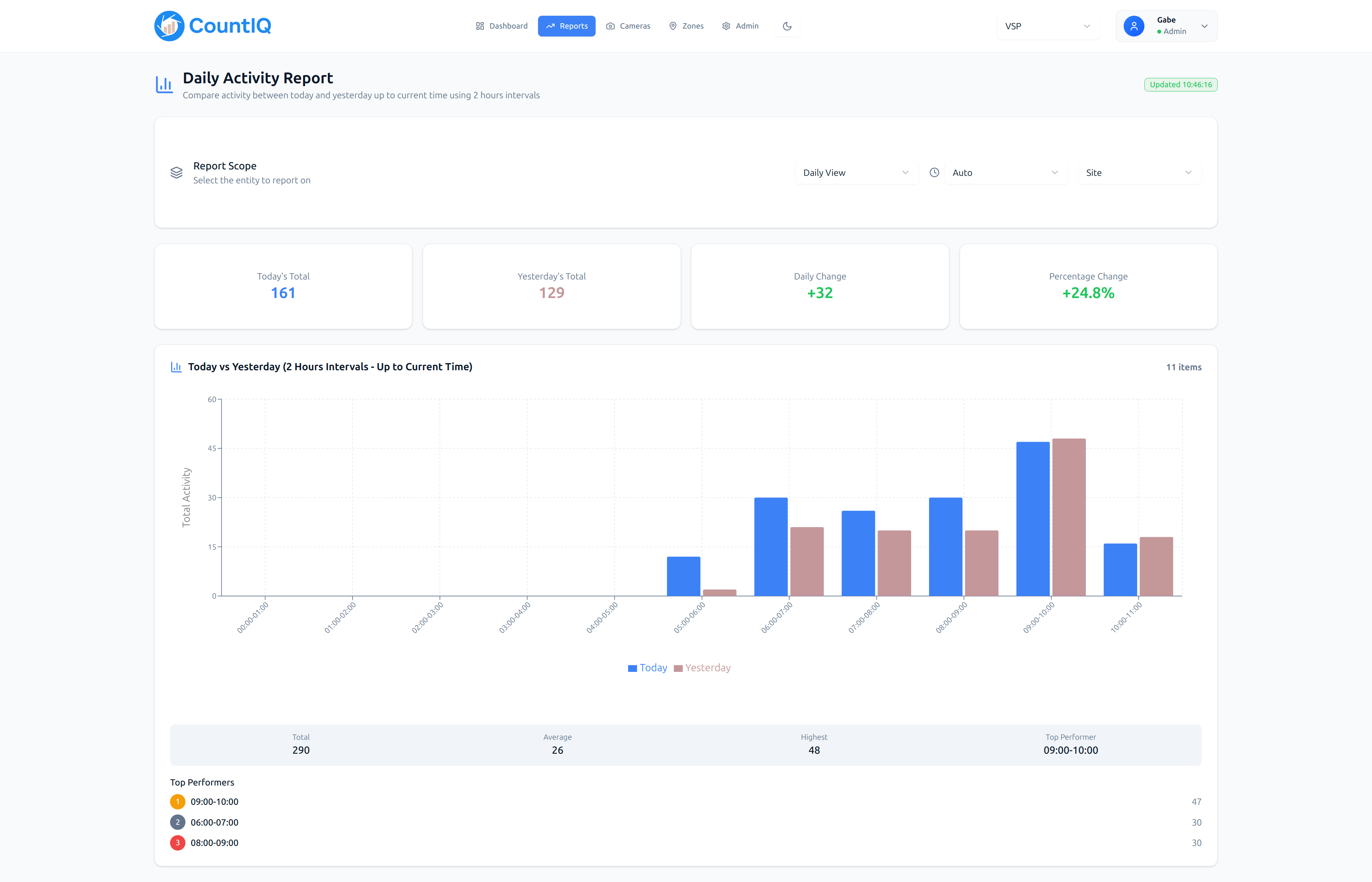
Daily Activity Reports
Compare activity between today and yesterday with detailed hourly breakdowns and percentage changes.
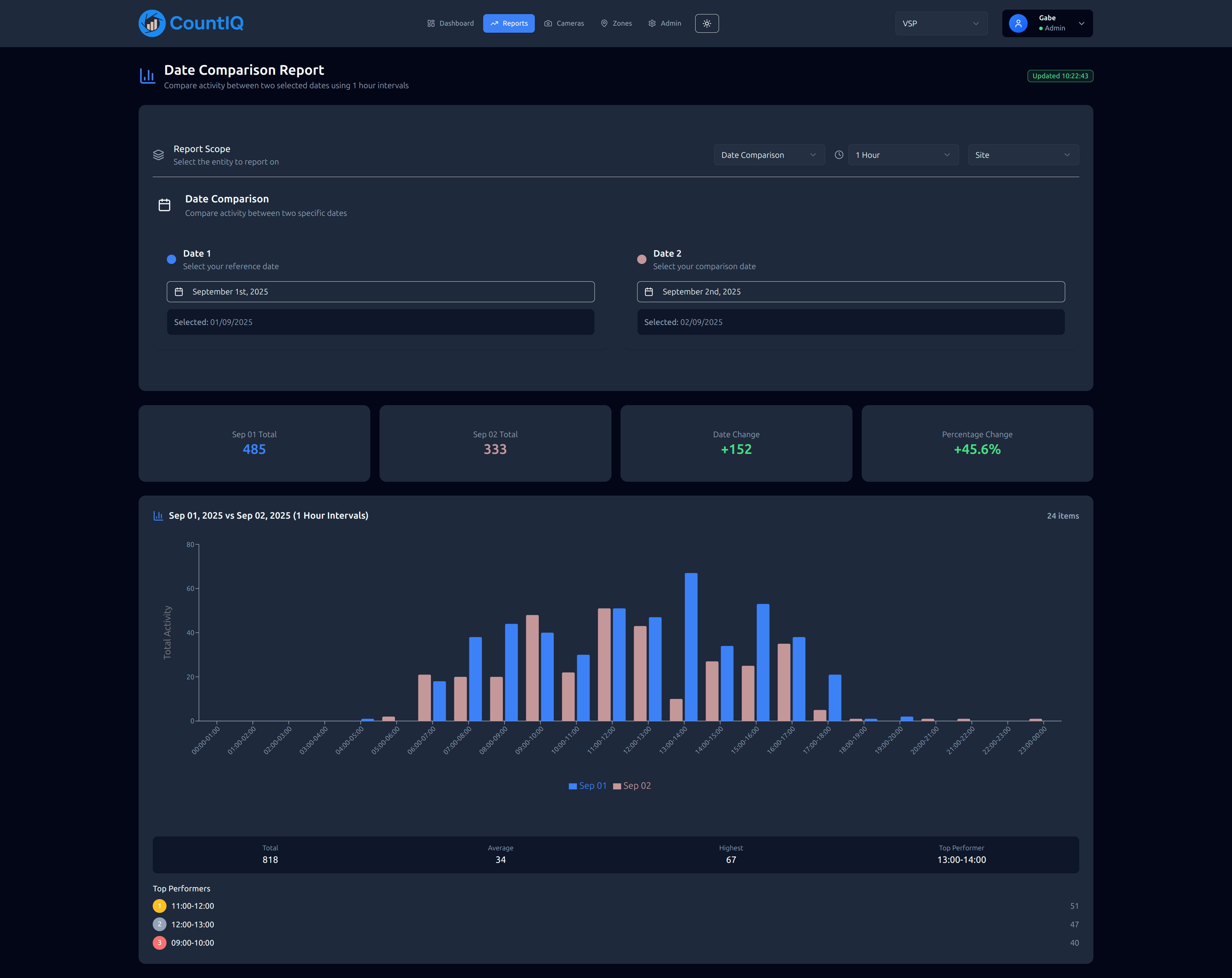
Date Comparison Analytics
Compare activity between specific dates with comprehensive insights and performance indicators.
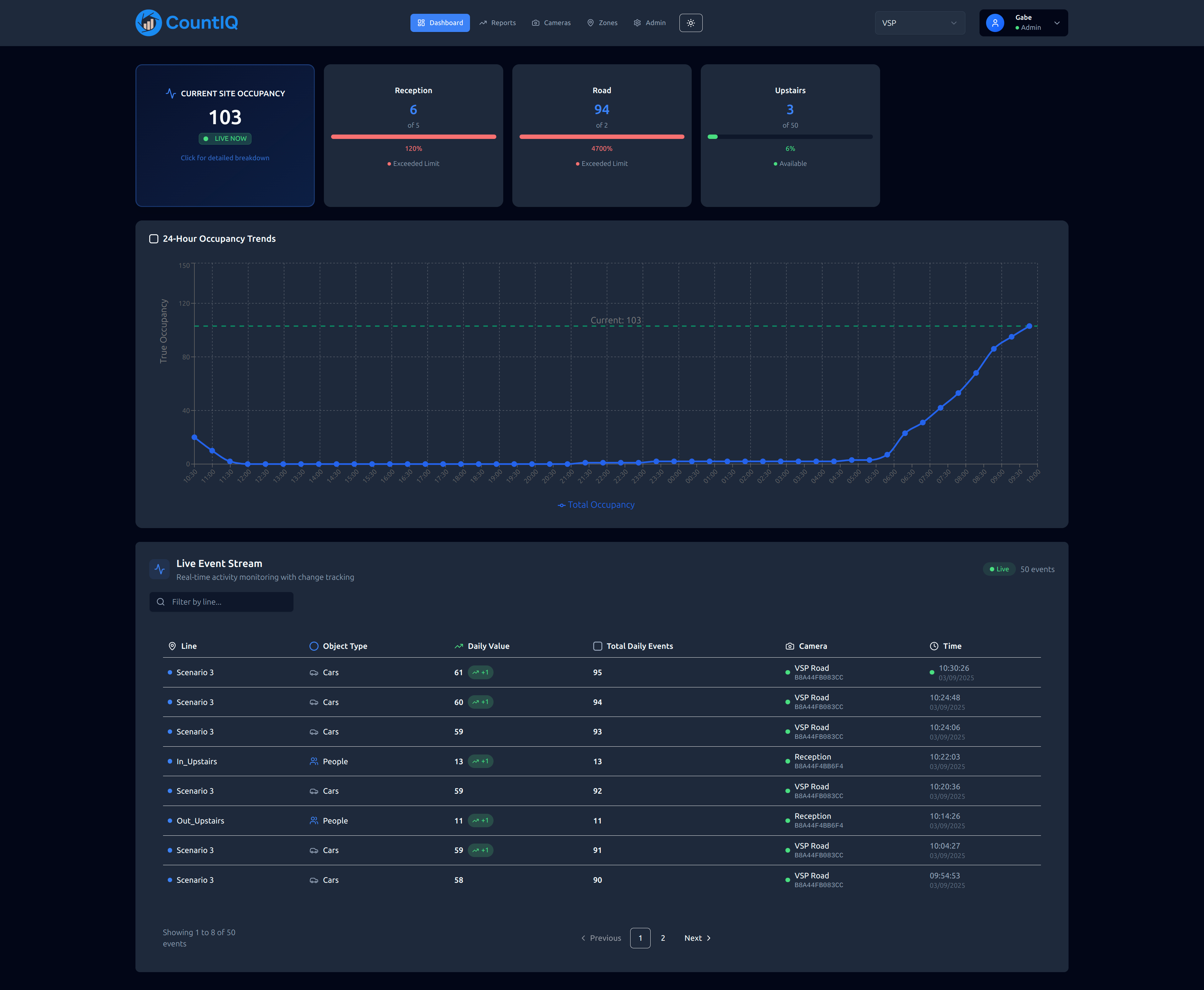
Live Dashboard & Event Stream
Real-time occupancy monitoring with 24-hour trends and live event tracking with detailed analytics.
People Counting System Benefits
Optimise Staffing
Know exactly when your busiest hours are and schedule staff to match actual demand — not guesswork.
Measure What Matters
Track the real impact of marketing campaigns, layout changes, and events on foot traffic and conversions.
Stay Compliant
Automatic capacity alerts and occupancy thresholds keep you compliant with safety regulations — no manual counting.
No New Hardware
If your Axis cameras are compatible, they do the counting. No dedicated sensor to buy, cable and mount at every entrance.
Real-Time Visibility
See live occupancy across every location from one dashboard — updates in seconds, accessible from anywhere.
Reports on Autopilot
Scheduled reports land in your inbox daily, weekly, or monthly — no manual data pulls needed.
People Counting by Industry
The counting is the same everywhere. What you measure and what you do with it is not. Supported analytics also count vehicles and bikes.
People counting for retail stores
Count shoppers at every store entrance, compare stores and work out conversion. CountIQ is a retail people counter that runs on compatible Axis cameras.
Read morePeople counting for shopping centres
Measure shopping centre footfall by entrance, zone and centre for leasing, marketing and operations. CountIQ counts on compatible Axis cameras.
Read moreOffice occupancy monitoring system for workplaces
See how many people use each floor, entrance and shared space. CountIQ is an office occupancy monitoring system that runs on compatible Axis cameras.
Read morePeople counting for hospitals and health facilities
Count patients, visitors and staff through hospital entrances and public areas using existing compatible Axis cameras, including on private networks.
Read morePeople counting for libraries and council facilities
Get a consistent visitor count for every library and council facility, with scheduled reports. CountIQ counts on compatible Axis cameras.
Read morePeople counting for venues and events
Track live occupancy by area, get alerts at capacity thresholds and report attendance. CountIQ counts on compatible Axis cameras at your entrances.
Read moreWhat to Check Before You Choose a People Counting System
Six questions to settle with any supplier, including us, before you commit.
Coverage
List every way in and out of the space. An uncounted side door or lift lobby makes every total wrong.
Hardware you already own
Ask whether your existing cameras can do the counting. If they can, you avoid a new device at every entrance.
Where counting happens
Find out whether counting runs on the device or on a server, and exactly what data leaves the site.
Validation
Agree how counts will be checked at your own entrances, for example against a manual count, before you rely on them.
Network and security
Camera networks are often private. Confirm how the system connects and what your security team will need to approve.
Reporting
Check that reports reach the people who need them on a schedule, and that multiple sites can be compared in one place.
Buying guides: Pricing · Axis people counting · Camera vs LiDAR vs thermal · Privacy
Frequently Asked Questions
What is a people counting system?
A people counting system uses cameras or sensors to count the number of people entering, exiting, or occupying a space in real time. Many modern systems run on compatible security cameras instead of dedicated sensors, providing footfall analytics, occupancy monitoring, and automated reporting.
How accurate are AI people counting systems?
AI-powered people counting systems using modern object analytics typically achieve 95–98% accuracy. Accuracy depends on camera placement, lighting conditions, and the analytics software. Systems using edge processing on the camera itself deliver the most reliable results as they process video in real time without network latency.
What is footfall analytics?
Footfall analytics is the measurement and analysis of pedestrian traffic patterns in a physical space. It tracks how many people visit a location, when peak hours occur, how traffic flows through different areas, and how these patterns change over time. Businesses use footfall data to optimise staffing, improve layouts, measure marketing effectiveness, and make data-driven decisions about their spaces.
What industries use people counting systems?
People counting systems are used across retail (foot traffic and conversion tracking), commercial real estate (occupancy monitoring and space utilisation), transport hubs (passenger flow and platform occupancy), public venues (event capacity management), corporate offices (hybrid work planning), and manufacturing sites (safety compliance and zone monitoring).
Can a people counting system use existing security cameras?
Yes. Modern people counting systems can work with existing security cameras that support on-camera analytics, such as Axis Object Analytics. This eliminates the need for dedicated people counting sensors and reduces deployment costs. The cameras process counting data locally using edge computing and send results to a cloud dashboard for reporting and alerts.
What is real-time occupancy monitoring?
Real-time occupancy monitoring tracks the number of people currently in a space at any given moment. It uses entry and exit counts from cameras to calculate live occupancy, with colour-coded capacity indicators and instant alerts when thresholds are reached. This is used for safety compliance, capacity management, and operational planning across multiple zones and sites.
Camera or LiDAR people counting: which should I choose?
Choose by the space. Cameras with on-board analytics suit doorways and defined zones, and can reuse compatible cameras you already own. LiDAR suits large open areas where no camera image is wanted, at a higher hardware cost and with specialist setup. Many sites only need entrances counted, which is where camera-based counting is the simpler option.
What does a people counting system cost?
Cost has three parts: counting hardware at each entrance, installation, and the software that stores and reports the counts. Dedicated sensors add a device, cabling and mounting to every doorway. A system that counts on compatible cameras you already own removes most of the hardware and installation cost, leaving the software and any camera adjustments.
Is people counting a privacy risk?
It depends on what the system collects. Systems that count on the device and send only count data collect far less than recorded video. Camera-based counting still involves a camera, so include it in your privacy assessment, notices and signage, and ask any supplier exactly what data leaves the site.
People counting in the field
See how operations and analytics teams use DDI Labs to turn the cameras they already have into reliable people and vehicle counts.
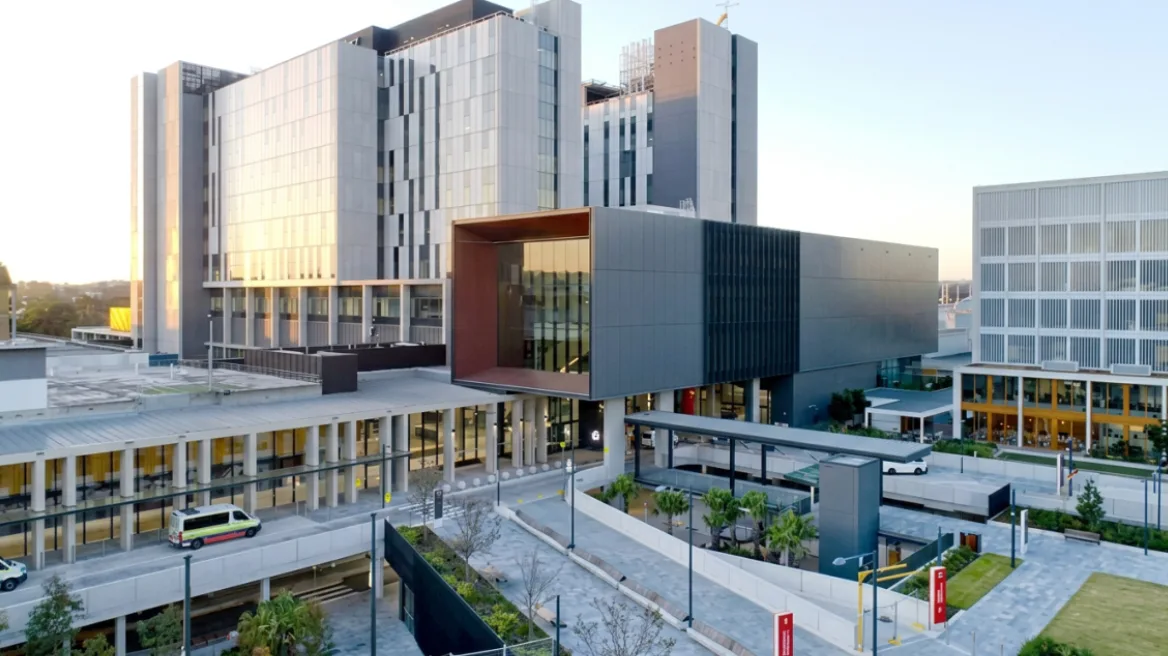

Get Started with People Counting
Ready to transform your space management with real-time people counting and occupancy insights? Get fast, flexible, and privacy-safe visibility into how every space is used.
Already using Axis cameras? See how CountIQ works with your existing Axis infrastructure →