
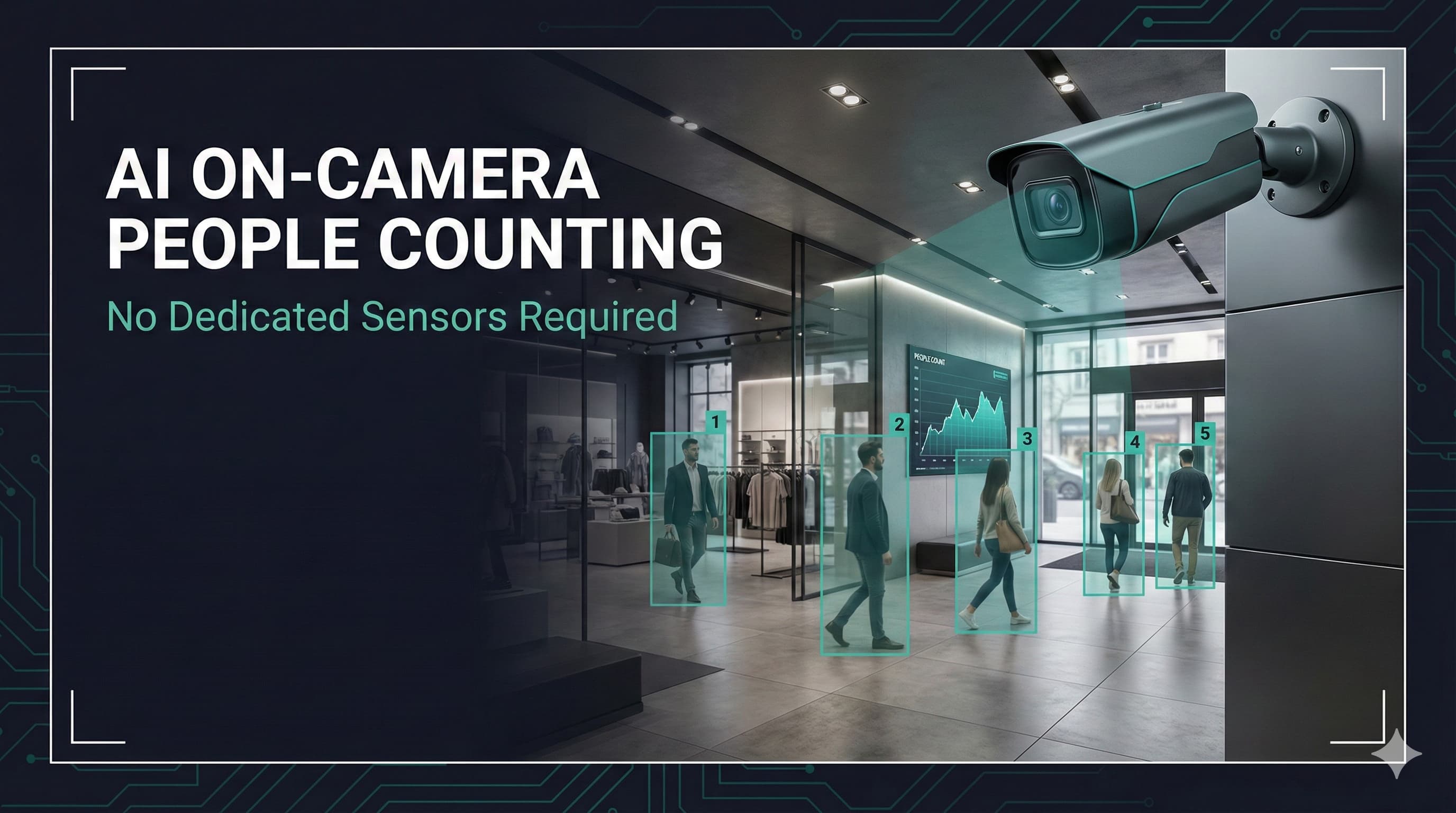
AI On-Camera People Counting: No Dedicated Sensors Needed
For years, if you wanted accurate people counting data, you bought dedicated sensors. Overhead thermal sensors, stereo-vision units, beam counters — purpose-built hardware installed at every entrance, connected to a proprietary backend, and maintained on a separate service contract. It worked, but it came with a cost structure and deployment model that locked out a lot of organisations that could have benefited from foot traffic analytics.
That's changed. AI-powered on-camera analytics now lets you run accurate people counting directly on standard surveillance cameras — the ones most buildings already have installed. No additional sensors, no separate network, no dedicated hardware budget.
This post breaks down what shifted, how on-camera AI people counting compares to the legacy approach, and what outcomes businesses are actually seeing.
Why dedicated people counting sensors used to be the only option
Traditional people counting systems relied on specialised hardware because general-purpose cameras simply weren't capable of running the analytics on-device. The processing power wasn't there, and the detection algorithms weren't mature enough to handle real-world conditions — varying lighting, occlusion, crowds, different angles.
So the industry settled on a model: install a dedicated sensor at each counting point, wire it into a controller or gateway, push data to a cloud platform, and pay per-device licensing. For a single entrance, this was manageable. For a multi-site retail chain, a campus, or a transport hub with dozens of entry points, costs scaled fast — hardware, installation, cabling, licensing, and ongoing maintenance all multiplied per counting point.
The hardware worked well within its constraints. But the deployment model created friction: long lead times for infrastructure planning, specialist installers, and rigid sensor placement that couldn't easily adapt when layouts changed.
What changed: AI on-camera analytics
Two things converged to make on-camera people counting viable.
First, edge AI processing matured. Modern IP cameras now ship with onboard processors capable of running deep learning models in real time. This means object detection, classification, and counting happen on the camera itself — no external server required for basic analytics.
Second, computer vision models got dramatically better. Modern object detection networks can reliably distinguish people from other objects in cluttered scenes, handle partial occlusion, track individuals across a frame, and maintain accuracy across lighting conditions. Five years ago, these models needed a GPU server. Today, optimised versions run on camera-grade chipsets.
The practical result: a standard surveillance camera with the right firmware or analytics application becomes a people counting sensor. If you already have cameras covering your entrances, lobbies, or corridors, you can enable foot traffic analytics without installing anything new.
On-camera AI vs dedicated sensors: a direct comparison
Here's how the two approaches stack up across the factors that matter most for deployment decisions.
| Factor | Dedicated Sensors | AI On-Camera Analytics |
|---|---|---|
| Hardware cost | Separate sensor per counting point | Uses existing cameras — no additional hardware |
| Installation | Specialist mounting, cabling, controller setup | Software deployment to existing camera network |
| Deployment speed | Weeks to months (procurement + install) | Days (configuration + calibration) |
| Accuracy | High (optimised for counting) | High (modern AI models match or exceed legacy sensors) |
| Scalability | Cost scales linearly per point | Marginal cost per camera is low — mostly licensing |
| Maintenance | Physical sensor upkeep + firmware updates | Software updates — no physical maintenance |
| Flexibility | Fixed position — moving sensors means reinstallation | Reconfigure counting zones in software |
| Additional analytics | Counting only | Counting + occupancy + dwell time + direction + heatmaps |
The accuracy gap that used to justify dedicated hardware has largely closed. For most commercial environments — retail, offices, campuses, transport hubs — AI on-camera analytics delivers comparable accuracy with significantly lower total cost of ownership.
Real outcomes businesses are seeing
The shift to on-camera AI people counting isn't just a technology swap. It's enabling outcomes that were previously too expensive or complex to justify.
- Staffing optimisation: Real-time foot traffic data lets managers align staffing levels to actual visitor patterns rather than guesswork. Retail stores are cutting overstaffing during quiet periods and ensuring coverage during peaks — directly reducing labour costs while improving service.
- Occupancy monitoring and compliance: Building managers use live occupancy data to enforce capacity limits, meet fire safety regulations, and satisfy post-pandemic occupancy requirements. Real-time occupancy dashboards replace manual headcounts and clipboard audits.
- Marketing and conversion measurement: Retailers measure the true impact of campaigns, window displays, and promotions by correlating foot traffic with sales data. Conversion rate — visitors vs. transactions — becomes a metric you can actually track and optimise.
- Energy and operational savings: HVAC, lighting, and cleaning schedules tied to actual occupancy rather than fixed timers. Buildings report measurable reductions in energy costs when systems respond to real-time people count data instead of running on static schedules.
- Space utilisation insights: Corporate campuses and co-working spaces use people counting to identify underused areas, right-size meeting rooms, and make data-driven decisions about lease renewals and floor plan changes.
These outcomes were all technically possible with dedicated sensors — but the cost and complexity of deploying them at sufficient scale made it impractical for many organisations. On-camera AI removes that barrier.
Faster deployment with cameras you already have
This is the point that often gets underestimated. Most commercial buildings, retail stores, and public venues already have IP camera networks installed for security. These cameras cover the exact locations — entrances, exits, lobbies, corridors — where people counting delivers the most value.
With AI on-camera analytics, enabling people counting is a software deployment. There's no infrastructure planning, no new cabling runs, no mounting brackets, and no coordination with building management for physical access. A camera that was previously only doing surveillance now simultaneously provides foot traffic analytics.
For multi-site organisations, this changes the rollout model entirely. Instead of a months-long procurement and installation programme across every location, you're deploying analytics software to an existing camera fleet. A 50-store retail chain can go from zero people counting to full coverage in a fraction of the time and budget that dedicated sensors would require.
What to look for in a people counting system
If you're evaluating people counting solutions — whether replacing legacy sensors or deploying for the first time — here's what matters:
- Accuracy in real conditions: Lab accuracy numbers are meaningless. Ask about performance in crowded scenes, varied lighting, and with occlusion. A good system should maintain 95%+ accuracy in typical commercial environments.
- Camera compatibility: The system should work with major camera brands — Axis, Hanwha, Avigilon, Milesight — and not lock you into a single vendor's ecosystem.
- Real-time dashboards and alerts: Data is only useful if it's accessible. Look for live occupancy dashboards, threshold-based alerts, and the ability to view data across multiple sites from a single interface.
- Historical reporting and exports: Trend analysis, comparisons across time periods, and the ability to export data via CSV or API for integration with business intelligence tools.
- Scalability: Adding a new counting point should be a configuration change, not a hardware project. Per-camera licensing with centralised management is the model that scales.
- Edge processing: Analytics that run on the camera (edge AI) reduce bandwidth requirements and latency compared to systems that stream video to a central server for processing.
Ready to enable people counting on your existing cameras?
CountIQ by DDI Labs delivers AI-powered people counting, occupancy monitoring, and foot traffic analytics — deployed on cameras you already have. No dedicated sensors, no infrastructure overhaul.
Explore People Counting SolutionsLooking for more information?
Keep exploring related pages on this topic.
Interested in Our Solutions?
Contact us today to learn how our smart tools can help your business improve safety and compliance.
Book a Demo