
Heavy vehicle inspections
Heavy vehicle site entry inspection checklist
A site entry inspection is the check a site makes on a heavy vehicle and its driver before letting them in. This checklist covers identity, driver, load, safety equipment and the record you keep. Adapt it to your site, your contracts and your project's CLOCS-A level.
This is an example checklist to adapt, not a statement of what the law requires at your site. It is not a roadworthiness inspection and does not replace the driver's daily check or the NHVR's inspection standards.
Three different checks
A site entry inspection is often confused with two other checks. They are done by different people for different reasons.
| Check | Who does it | When | Purpose |
|---|---|---|---|
| Daily or pre-start check | The driver or operator | Before the vehicle is used | Confirm the vehicle is safe to drive |
| Site entry inspection | The site | On arrival at the gate | Confirm the vehicle, driver and load meet the site's requirements |
| Roadworthiness inspection | Authorised inspectors | Periodically, or when directed | Assess the vehicle against vehicle standards |
1. Vehicle identity
- Number plate recorded, and it matches the booking or delivery notice.
- Registration is current.
- Vehicle type and configuration are what the site expected.
- Operator or company name recorded.
- Vehicle is not on the site's exclusion list.
2. Driver
- Driver's licence sighted, and the class suits the vehicle.
- Driver's name matches the booking where one was made.
- Site induction is current.
- Evidence of vulnerable road user training, where the project requires it.
- Driver confirms the route they were given and any site-specific instructions.
3. Load and restraint
- The load matches the paperwork.
- The load is restrained, with no visible movement or loose items.
- Loose material is covered or tarped where required.
- Vehicle and load are within the height limit for the site and its approach.
- Weighbridge docket or mass declaration recorded, where available.
4. Safety equipment
For projects that have adopted CLOCS-A, check the equipment required at the project's level. The Bronze list is below. Other sites should set their own list.
- Class V and Class VI mirrors fitted.
- Fresnel lens on the passenger door window or peeper window.
- Flashing amber beacons working.
- Reversing beeper working.
- Rear-view camera or reversing sensors working.
- Conspicuity marking and warning signage in place.
- Wheel-nut indicators present on all wheels.
5. Outcome and record
- Result recorded: accepted, accepted with conditions, or refused.
- Photos taken of the vehicle, the plate and any defect.
- Inspector's name and the time recorded.
- For a refusal or a condition: what was wrong, what was done and who was told.
- The operator is notified of any failure.
- The record can be retrieved later by date, plate and site.
Why the record matters as much as the check
An inspection that leaves no trace cannot be shown to anyone. Under the Heavy Vehicle National Law, each party in the Chain of Responsibility has to ensure the safety of its transport activities so far as is reasonably practicable. If your site is ever asked what it did, the answer is the record: which vehicles were checked, what was found and what happened next.
Paper checklists make that hard. Entries are incomplete or illegible, sheets are stored at the gatehouse, and nobody can say which vehicles were on site last Tuesday.
Running this checklist in SiteInspector
Vehicle classification is filled in from the vehicle registry, and driver details can be captured by scanning the licence, so the inspector checks the vehicle instead of typing.
- Licence plate recognition logs every vehicle entering and leaving, with time, direction and plate images.
- Each plate is matched against your vehicle registry, with alerts for unregistered, expired or blacklisted vehicles.
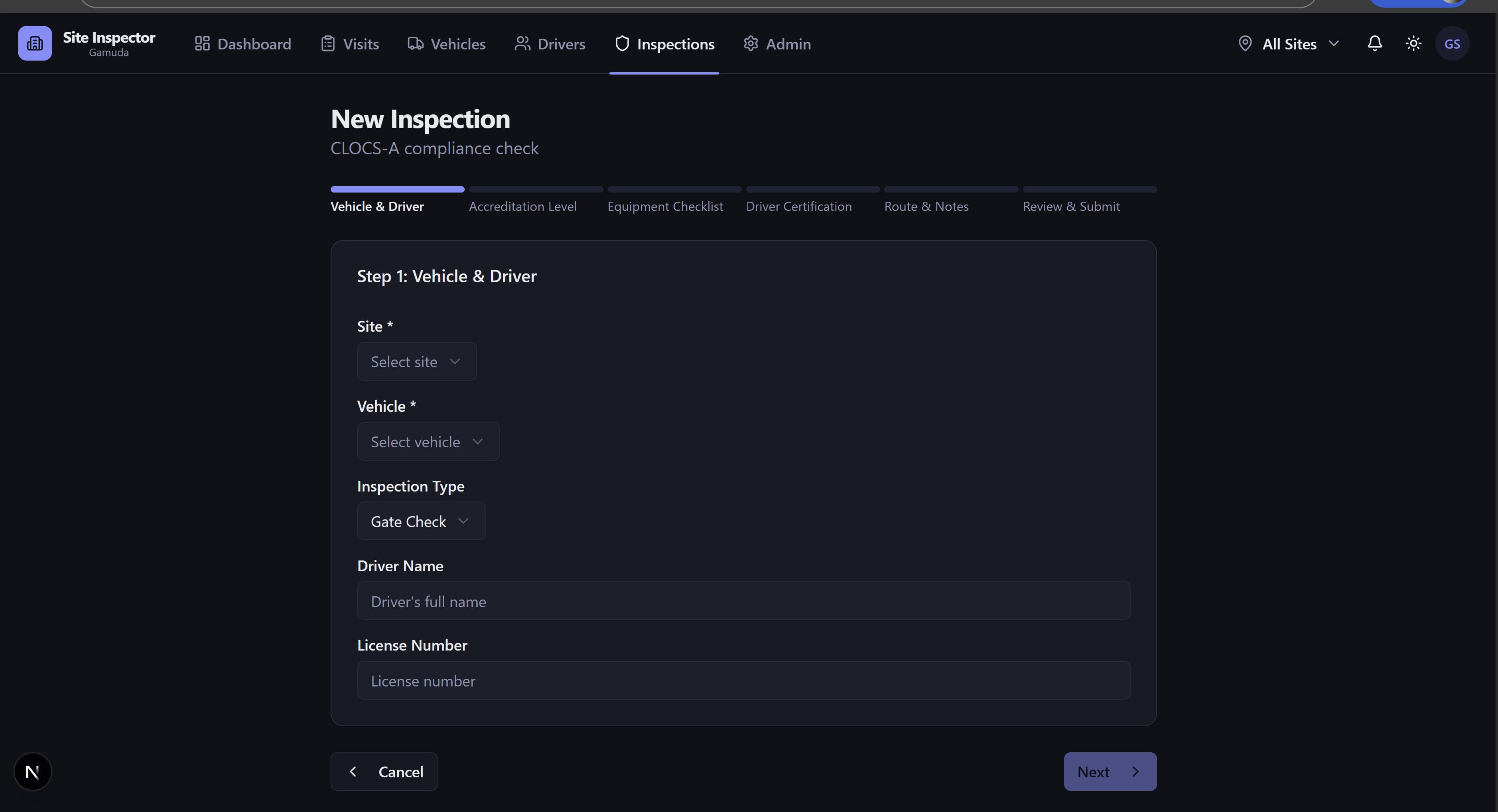
- Digital gate check inspections follow a guided workflow: vehicle and driver, accreditation, equipment checklist, driver certification, route and notes, then review and submit.
- Alerts carry an acknowledgement workflow that records who responded and when.
- Records from every site sit in one place, with role-based access.
Common questions
What is the difference between a pre-start check and a site entry inspection?
A pre-start check is done by the driver or operator before the vehicle is used, to confirm it is safe to drive. A site entry inspection is done by the site when the vehicle arrives, to confirm the vehicle, driver and load meet the site's own requirements.
Is a site entry inspection a legal requirement?
The primary duty does not specify a gate inspection. It requires each party in the Chain of Responsibility to ensure the safety of its transport activities so far as is reasonably practicable. For a site that loads, unloads or receives heavy vehicles, checking what arrives is one way to do that and to evidence it. Contracts and standards such as CLOCS-A can add their own requirements.
What should a heavy vehicle site inspection include?
Cover five areas: vehicle identity and registration, the driver and their credentials, the load and its restraint, the safety equipment your site or project requires, and the outcome with a record of any action taken.
How long should inspection records be kept?
Keep them for as long as your safety management system, your contracts and your advisers require. The practical test is whether you could produce the record for a specific vehicle and date if asked well after the project has finished.
Can site entry inspections be done digitally?
Yes. A digital inspection applies the same steps to every vehicle, attaches photos and timestamps, and makes records searchable across sites. SiteInspector provides a guided inspection workflow alongside automatic licence plate recognition at the gate.
Site compliance in the field
See how infrastructure and construction teams use SiteInspector to digitise vehicle inspections and Chain of Responsibility checks.


Ready to Start Your Automation Journey?
Our team is ready to discuss how our AI solutions can address your specific business challenges.
sales@ddilabs.ai
Location
Sydney, Melbourne, Brisbane