
Construction logistics and community safety
CLOCS-A explained: accreditation levels, requirements and site checks
CLOCS-A (Construction Logistics and Community Safety Australia) is a national voluntary standard for managing the road safety risks of a construction project's heavy vehicle movements. Projects are rated Bronze, Silver or Gold, and the organisations working on them are expected to hold accreditation at that level or higher.
This page is general information. CLOCS-A requirements are set and revised by the CLOCS-A program; check clocs-a.org.au and your contract for the current standard.
What CLOCS-A is
CLOCS-A is a national good practice approach for managing the risks and impacts that construction projects have on the road network through their transport and logistics. It was inspired by the UK's CLOCS program and has the same aim: fewer deaths and serious injuries involving construction vehicles and vulnerable road users such as pedestrians and cyclists.
The program is funded through the National Heavy Vehicle Regulator's Heavy Vehicle Safety Initiative, supported by the Federal Government. The standard covers four areas: heavy vehicles, drivers, logistics planning and communications.
CLOCS-A is voluntary. It applies to your work when a project chooses to participate, which in practice means when the client or principal contractor writes it into the contract.
Who needs accreditation
| Organisation | Accreditation type | Covers |
|---|---|---|
| Developers and principal contractors | Construction | The project and its sites |
| Transport operators | Transport | Commercial vehicles over 4.5 tonnes and their drivers |
| Organisations that do both | Combined construction and transport | Sites, vehicles and drivers |
Vehicles under 4.5 tonnes can also be brought under the standard where a client's contract requires it.
Bronze, Silver and Gold
A project is given a level using the CLOCS-A Project Rating Tool. The tool scores the project on factors including its cost, local population density, the number of heavy vehicle visits each day, and nearby schools and intersections. The more exposure a project creates for vulnerable road users, the higher its level.
Once a project is rated, participants are expected to hold accreditation at that level or higher. A Silver project needs participants at Silver or Gold. Accreditation is valid for 24 months, and unannounced visits may take place after it is granted.
Bronze vehicle requirements
Bronze is the entry level. At the time of writing, the Bronze vehicle requirements published by CLOCS-A are:
- A Fresnel lens on the passenger door window or peeper window.
- Flashing amber beacons on the cab roof.
- Class V and Class VI mirrors.
- A reversing beeper on the truck, the trailer or both.
- Retro-reflective conspicuity marking on the sides and rear of trucks and trailers.
- Brightly coloured drawbars on dog trailers.
- Warning signage on the left rear of trucks and trailers.
- Wheel-nut position indicators or retainers on all wheels.
- A rear-view camera with an in-cab screen, or a reversing sensor system.
What a site needs to be able to show
Accreditation sits with organisations. A project still has to know, vehicle by vehicle, that what turns up at the gate meets the level it has committed to. CLOCS-A does not prescribe how a site does that. In practice it comes down to being able to answer these questions for any day of the project.
- Which heavy vehicles attended each site, and when.
- Whether each vehicle's operator held accreditation at the required level.
- Whether the required safety equipment was fitted and working.
- Who was driving, and whether they had completed the required vulnerable road user training.
- What happened when a vehicle or driver did not meet the standard.
CLOCS-A and Chain of Responsibility
They are different things. Chain of Responsibility is law: the Heavy Vehicle National Law gives every party in the chain a primary duty to ensure the safety of its transport activities. CLOCS-A is a voluntary standard focused on the safety of people outside the vehicle, around construction projects.
They meet at the site gate. The record of which vehicles arrived, in what condition and with which driver serves both.
How SiteInspector supports CLOCS-A
Gamuda Australia uses SiteInspector on the Sydney Metro West Western Tunnelling Package, across seven construction sites.
- Licence plate recognition logs every vehicle entering and leaving, with time, direction and plate images.
- Each plate is matched against your vehicle registry, with alerts for unregistered, expired or blacklisted vehicles.
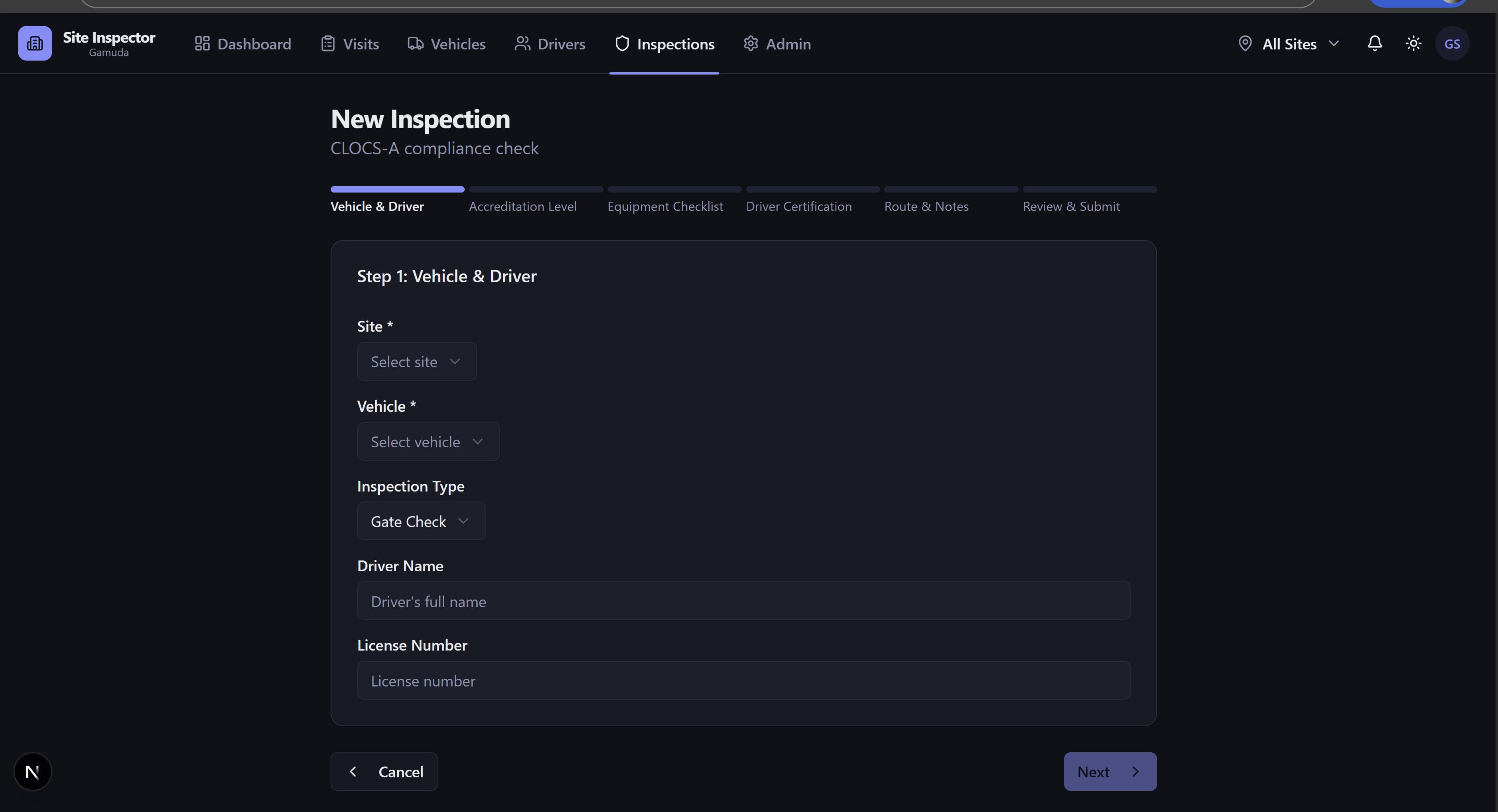
- Digital gate check inspections follow a guided workflow: vehicle and driver, accreditation, equipment checklist, driver certification, route and notes, then review and submit.
- CLOCS accreditation levels are tracked per site as Bronze, Silver or Gold.
- Driver licence scanning captures driver details at the gate.
- Every inspection is kept as a digital record for audit and compliance evidence.
Common questions
What does CLOCS-A stand for?
CLOCS-A stands for Construction Logistics and Community Safety Australia. It is a national good practice approach for managing the road safety risks created by construction projects' transport and logistics, inspired by the UK's CLOCS program.
Is CLOCS-A mandatory?
No. CLOCS-A describes itself as a national voluntary standard. It becomes a requirement for your organisation when a project you work on adopts it, usually through the contract with the client or principal contractor.
What are the CLOCS-A Bronze, Silver and Gold levels?
They are three levels of requirements covering vehicles, drivers, logistics planning and communications. A project is rated using the CLOCS-A Project Rating Tool, and participants are expected to hold accreditation at the project's level or higher.
Which vehicles does CLOCS-A apply to?
CLOCS-A transport accreditation applies to commercial vehicles over 4.5 tonnes. Lighter vehicles can be included where a client's contract requires it.
How long does CLOCS-A accreditation last?
CLOCS-A accreditation is valid for 24 months. Accredited organisations are expected to keep complying in that time, and unannounced visits may take place after accreditation is granted.
Is CLOCS-A the same as Chain of Responsibility?
No. Chain of Responsibility is a legal duty under the Heavy Vehicle National Law. CLOCS-A is a voluntary standard for construction logistics. A site can be subject to both, and the same gate records help evidence each.
Site compliance in the field
See how infrastructure and construction teams use SiteInspector to digitise vehicle inspections and Chain of Responsibility checks.


Ready to Start Your Automation Journey?
Our team is ready to discuss how our AI solutions can address your specific business challenges.
sales@ddilabs.ai
Location
Sydney, Melbourne, Brisbane