
Car park occupancy
Car park counting systems and live occupancy
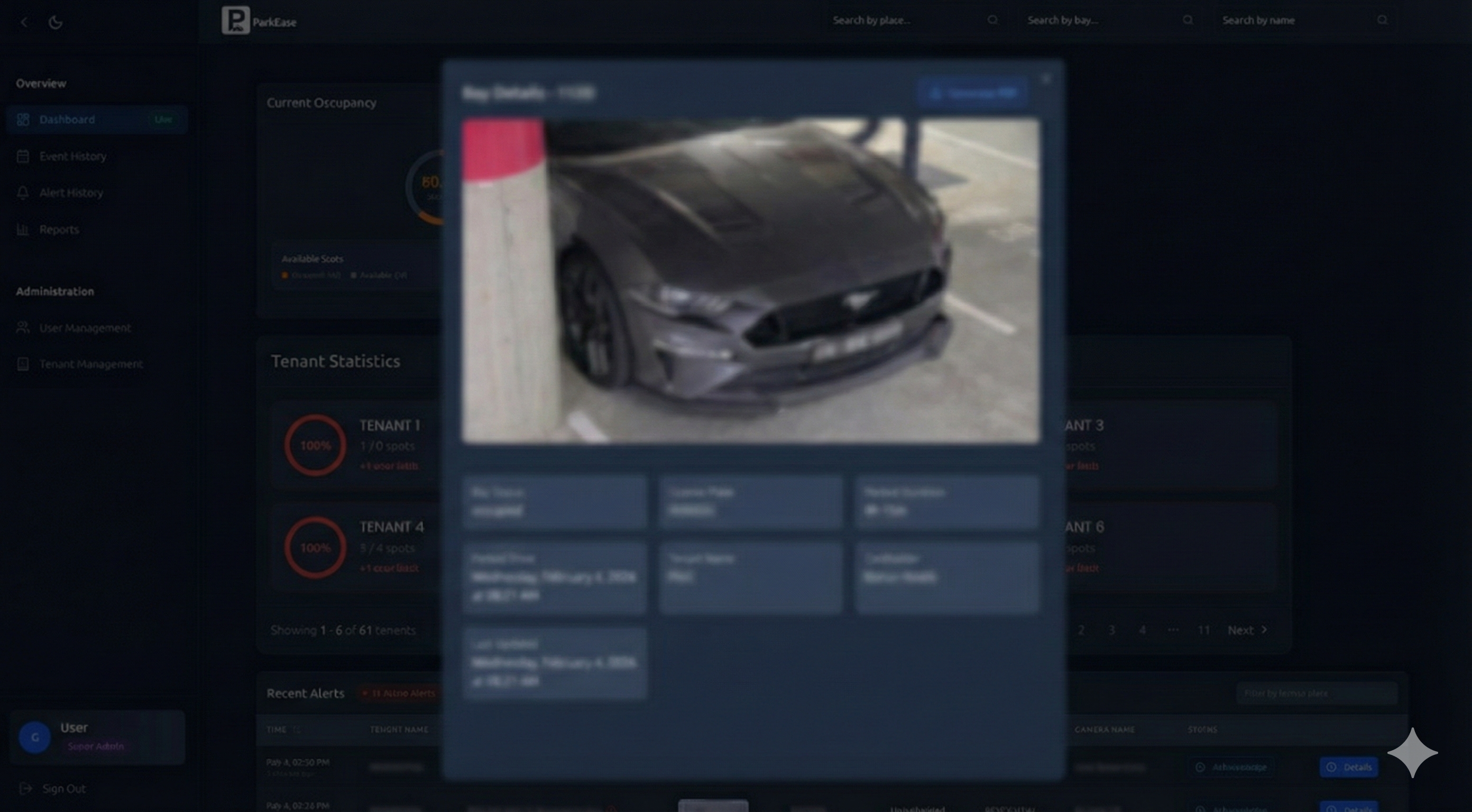
A car park counting system tells you how many vehicles are in a car park, level or zone right now, and how that changes through the day. The common methods are counting vehicles in and out at each entry, sensing each bay, or reading number plates. ParkEase shows live occupancy by building and by tenant using plate recognition at entries and exits.
Four ways to count a car park
| Method | How it works | What it tells you | Limits |
|---|---|---|---|
| Entry and exit counting | Loops or cameras count vehicles in and out at each access point | Total occupancy of a car park or level | Small errors add up over a day, and it cannot say whose vehicles they are |
| Bay sensors | A sensor in or above every bay detects whether it is occupied | Exactly which bays are free | A device to install and maintain for every bay |
| Camera bay detection | Cameras watch groups of bays and detect vehicles in them | Which bays are free, without a sensor in each one | Needs clear lines of sight, which pillars and low ceilings interrupt |
| Plate recognition | Cameras read each number plate at entry and exit | Occupancy, plus which tenant or booking each vehicle belongs to | Only as useful as the plate list behind it |
Choose by what you need the number for
If what you want is a red or green light above every bay, that is a parking guidance system, which is a different purchase from an occupancy and access system.
| If you need to | Look at |
|---|---|
| Show drivers whether the car park is full | Entry and exit counting |
| Guide drivers to a free bay | Bay sensors or camera bay detection |
| Know which tenant is using how many bays | Plate recognition |
| Report vehicle traffic through an entrance over time | Entry and exit counting |
| Detect vehicles that should not be there | Plate recognition |
Why a count drifts
Any system that works from entries minus exits needs every access point covered and a way to correct itself. Plate-based systems have an advantage here: a vehicle that was read in and read out is known to have left.
- Two vehicles pass a counter close together and are counted as one.
- A vehicle reverses back out over the counter.
- An entry or exit is not counted at all, such as a roller door used by contractors.
- The count is never reset, so yesterday's errors carry into today.
Where DDI Labs fits
- ParkEase shows real-time occupancy by building and by tenant, with every vehicle event logged with a timestamp and camera snapshot.
- ParkEase alerts when tenants approach or exceed their allocation, and when a vehicle parks without authorisation.
- CountIQ reports vehicle counts through an entrance over time, using supported analytics on compatible Axis cameras.
Common questions
What is a car park counting system?
A car park counting system measures how many vehicles are in a car park, level or zone. It does this by counting vehicles in and out, by sensing individual bays, or by reading number plates at the entries and exits.
How do car parks know how many spaces are free?
Either by subtracting vehicles that have left from vehicles that have entered, or by detecting whether each bay is occupied. The first gives a total for the car park or level. The second gives the status of every bay.
What is the difference between car park counting and parking guidance?
Counting gives you occupancy numbers. Parking guidance uses bay-level detection to direct drivers to a free space, usually with signs and a light above each bay. Guidance needs detection at every bay; counting does not.
Can number plate recognition count vehicles?
Yes. Each plate read at an entry adds a vehicle and each read at an exit removes one. Because every vehicle is identified, the count can also be broken down by tenant or booking, which a simple counter cannot do.
Can ParkEase show occupancy by tenant?
Yes. ParkEase provides real-time occupancy tracking by building and by tenant, and alerts when a tenant approaches or exceeds its allocation.
Ready to Start Your Automation Journey?
Our team is ready to discuss how our AI solutions can address your specific business challenges.
sales@ddilabs.ai
Location
Sydney, Melbourne, Brisbane